Thursday, January 20, 2011

Davidgareja - one of the most remarkable religious and cultural centres of Georgia


Davidgareja, one of the most remarkable religious and cultural centres of feudal Georgia, is a cave monastic complex, situated in a rocky mountainous terrain in the historical region of Gareja, 60-70km south-east of Tbilisi. The Monastery was founded in the first half of the 6th century by David Garejeli, one of the Assyrian Fathers. The Holy Father came to the Gareja wilderness with his disciple Lukiane and took up his abode in a small, natural cave, thus laying the foundation to a monastery which, in later centuries, came to be known as St David’s Lavra. St David’s Lavra was the centre of the monastic life in gareja. In the course of time it was joined by new monasteries whose number, at a certain time, reached twelve. The appelation "The Twelve Gareja Monasteries" must have come down from that time.


The activity of the David Gareja Monasteries was an important part of the religious, as well as, cultural life of the Georgian people. In the early 12th century King David IV, the Builder, made the monasteries royal property, freed them from taxes, and facilitated their advancement. In 1265 Davidgareja and its environs were sacked and ravaged by the Mongol hordes led by Berka Khan. In the first half of the 14th century, during the reign of King Giorgi the Illustrious, Davidgareja yielded a potent political and economic power. The helmsmen of the monasteries were members of the Royal Council, and took part in the government of the Georgian Church. The monastic life was disrupted at Davidgareja by numerous invasions of Tamerlane at the close of the 14th century. In 1424 King Alexander 1, the Great, donated Davidgareja to the Patriarchal Church of Svetitskhoveli in Mtskheta. 


After the ravage wrought by the Persians during the  invasion of 1616-1617 the Monasteries ceased to exist. In 1629 King Teimuraz I revived the monastic life here. In the 18th century Davidgareja came under direct royal protection again. It owned extensive estates and villages, the peasants living in them were considered monastic serfs. The monastic life at Davidgareja did not stop till the close of the 19th century. The monastic construction at Davidgareja reached its peak during the cultural, political, and economic upswing in Georgia, in late 12th and early 13th centuries. Davidgareja developed its own way of life, style of construction, and school of mural painting.


The appearance of the Davidgareja monasteries of this epoch was totally different from the monastic style of the previous centuries. The former simplicity and spontaneity of the main Churches and refectories gave way to magnificence and grandour, to a tendency towards more free space. The murals on the walls of these Churches, and common refectories intensified the impression. The importance of the Davidgareja murals is heightened by the numerous portraits of the contributors, including the portraits of the Georgian royalty: Queen Tamar and her son Giorgi Lasha (the Bertubani Church). The size of the donors’ portraits is much larger than that of the religious personages, which demonstrates the freedom of the Georgian master from the rules set by the Byzantine art. The frescos of the Bertubani refectory are remarkable for the solemn and magestic impression they create. The frescos in the main Udabno Church depict episodes from David Garejeli’s life. The frescos in the apse of Udabno’s Ascension Church are equally interesting with the vital ity and expressiveness of their characters.In late feudal times the monastic complexes communicated by means of watch and signal towers, which came down to us in ruins. Some of the 17th and 18th century caves present a certain interest for their plaster embellishments. Davidgareja was an influential cultural and enlightenment centre. Prominent men of letters were engaged in scholarly work here at various times.





Thursday, January 13, 2011

Alaverdi - Georgian Orthodox Cathedral in Kakheti, Georgia


Traveling on Holidays to Georgia you have to see one of the main attractions of Georgia - Alaverdi Monastery in Kakheti.

Alaverdi Monastery (Georgian: ალავერდი) is one of the biggest and most beautiful Georgian Orthodox monastery located 20 km from Telavi, in the Kakheti region of Eastern Georgia. Parts of the monastery date back to 6th century. The present day cathedral dates to the 11th century. Till now it’s a source of great pride and love for the local people.
The monastery was founded by the Assyrian monk Joseph (Yoseb, Amba) Alaverdeli, who came from Antioch and settled in Alaverdi. Later in 11th century the Kakhetian King Kvirike built the great Alaverdi Cathedral at the site of St George’s small Church. The cathedral has been damaged several times during invasions, and by earthquakes, especially in the 15th and 18th centuries.
At a height of over 55 meters, Alaverdi Cathedral is the second tallest Church in Georgia, after the recently consecrated Tbilisi Sameba Cathedral.

Monday, January 10, 2011

Gudauri, One of the Most Beautiful Ski Resort in Georgia


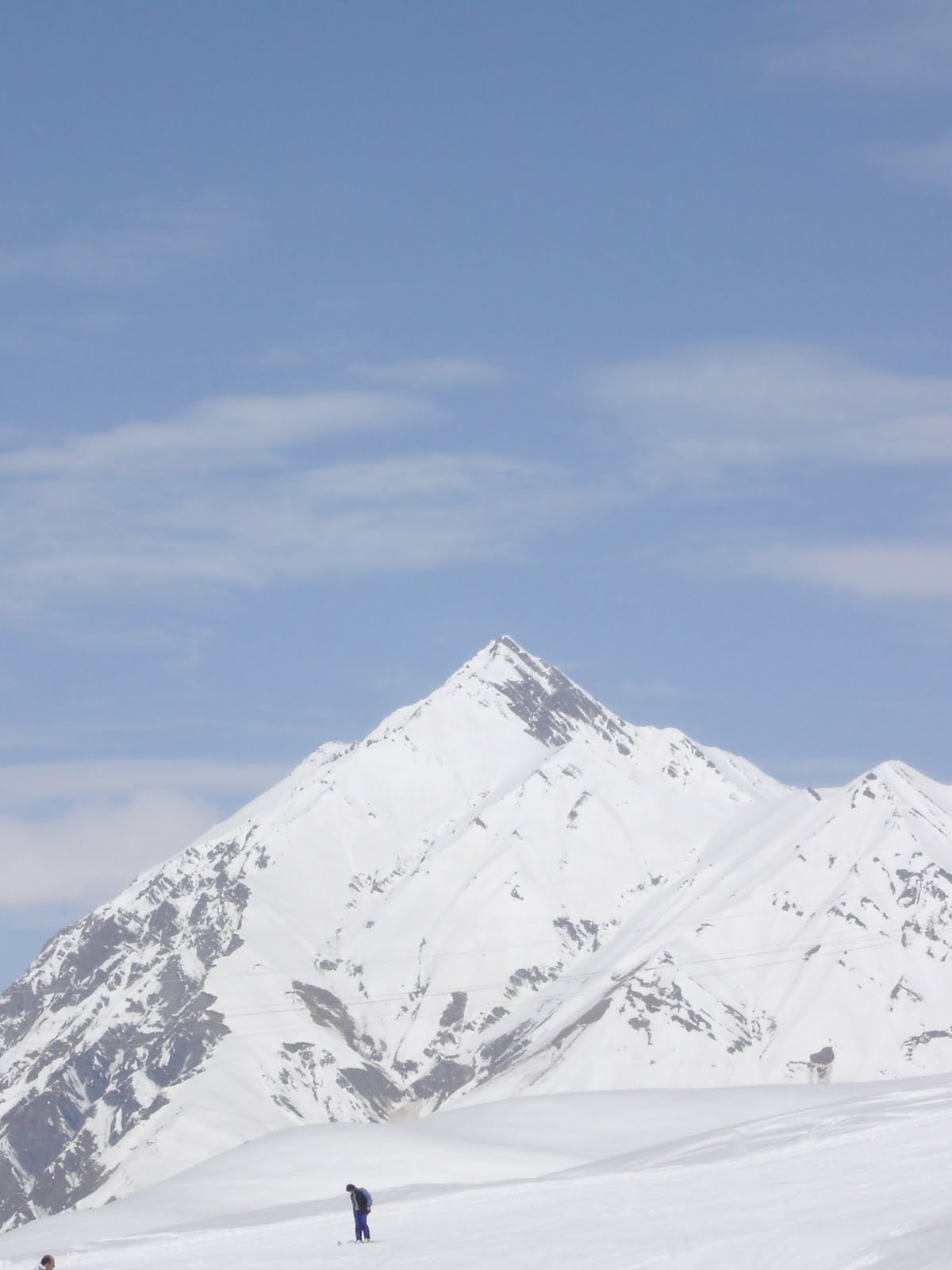
Gudauri is a ski resort located on the southern slopes of The Greater Caucasus Mountain Range in Georgia. The resort is situated in the Stepantsminda District, along the Georgian Military Highway near the Cross Pass, at an elevation of 2,196 meters (7,200ft.) above sea level. Gudauri lies 120 km (75 miles) to the north of the capital Tbilisi. The trip from Tbilisi to Gudauri usually takes two hours by car. The resort offers high quality skiing opportunities. The slopes of Gudauri are completely above the tree line and are best for free-riders and are generally considered to be avalanche-safe. The ski season lasts from December to April. Heliskiing is also available throughout the season.


Heliskiing is one of Gudauri's most distinctive offerings and it provides skiers with access to some of the finest powder-snow in the Caucasus. With helicopters granted almost unrestricted access to local mountains, skiers can experience some of the most sublime runs in Europe - at altitudes between 1,500 and 4,200 meters above sea level. The helicopters drop clients off on mountain tops, glaciers, fabulous ridges - and in the hands of highly experienced guides.


Gudauri contains several routes and lifts. The first, lower lift station is at 1,990m above seal level and the last, top station is at 3,306m, called Sadzele. The lifts are by Doppelmayr.


The first lift is 1,010 m long (three chairs), the second – 2,310 m long (four chairs) and the third – 1,060 m long (three chairs). The lift usually works from 10 to 16-17.

Friday, December 17, 2010

Video from Venice


Traveling for holidays to Venice it was just one small video that I've captured in one of the Venice canals. You can listen traditional Italian music that echoed from the walls of narrow canals.

Sunday, December 5, 2010

Caucasus, Georgia - the Photo Gallery

As you know the northern border of Georgia is Caucasian mountains. Traveling for holidays to Georgia you could not leave this part of the country without interest. To assure all of you in this suggestion I put here just couple of photos.

                                
                                                                            panoramic view


Mount Kazbek (5033 m = 16.512 ft) (Georgianყაზბეგი (or მყინვარწვერი)OsseticСæнаRussianКазбекChechenБашлам), is a dormantstratovolcano and one of the major mountains of the Caucasus located on the border of Kazbegi District of Georgia and North Ossetia[3]. It is the third highest mountain in Georgia (after Mount Shkhara and Janga) and the seventh highest peak in the Caucasus Mountains. The summit lies directly to the west of the town of Stepantsminda and is the most prominent geographic feature of the area. The name in GeorgianMkinvartsveri, translates to "glacier" or "Ice Mountain". The Vainakh name Bashlam translated as Molten Mount.


On the photo you can mention one of the most beautiful architectural buildings in Georgia the Trinity Church of Georgeti


...and again mount Kazbeg early in the morning...


The panoramic view of Gergeti Trinity Church.


...and clouds, mounts, church...

Shio-Mgvime Monastery

To spend your holidays in Georgia (Europe, Caucasus) is quite interesting thing while traveling around the country you can find sign of Ancient Greeks (golden fleece) and Romans. First Christianity (since beginning of 4th century) and Iberia and old Colchis.


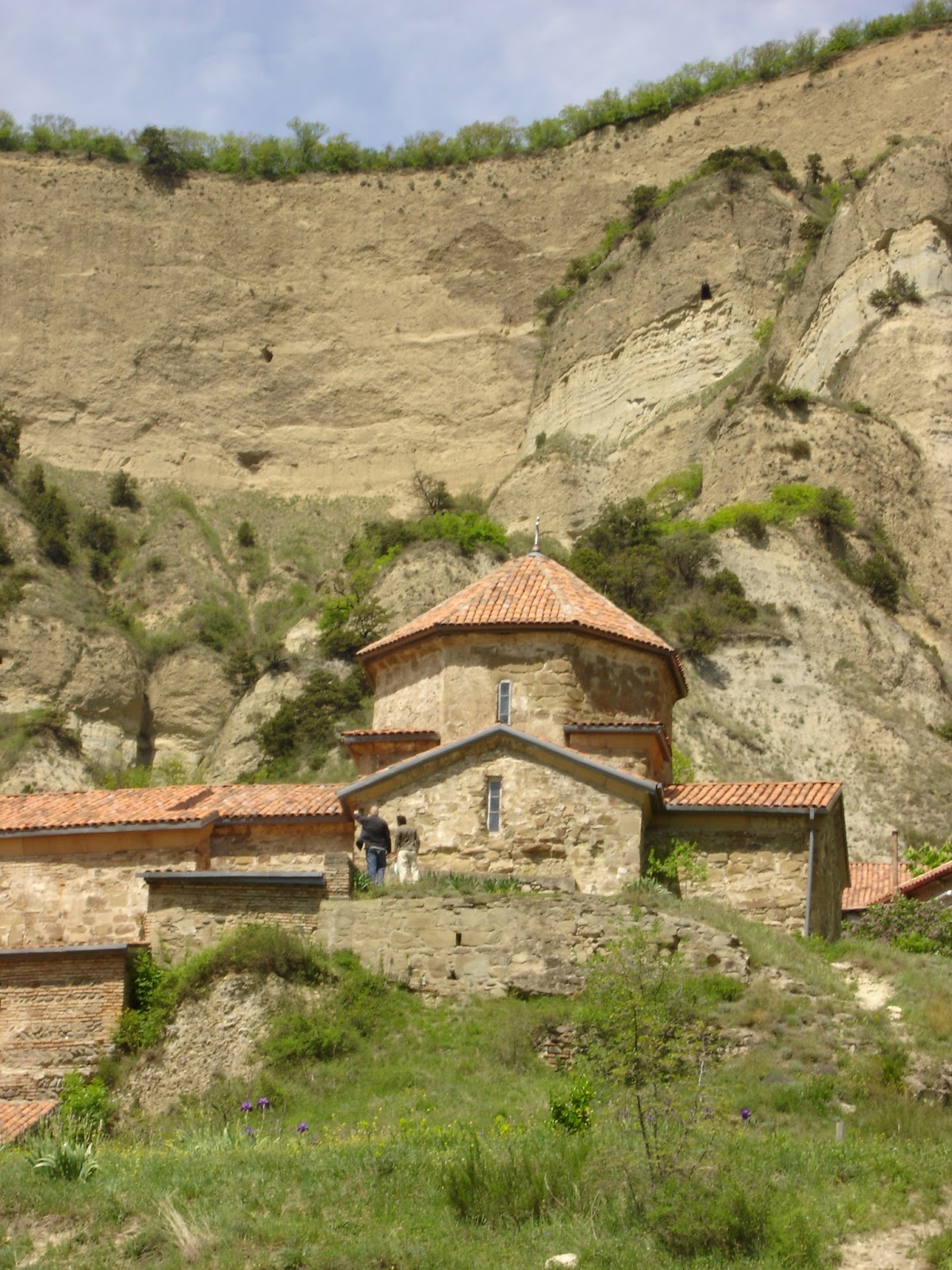
Shio-Mgvime charch and monastery complex is located nearby from ancient Georgian capital Mtskheta.The first monastery community at this place was founded by the 6th-century monk Shio, one of the Thirteen Assyrian Fathers who came to Georgia as Christian missionaries.

Shio-Mgvime quickly turned into the largest monastic community in Georgia and by the end of the 6th century it was populated by as many as 2,000 monks. It became a vibrant center of cultural and religious activities and remained under the personal patronage of Catholicoi of Georgia. David IV "the Builder" (1089-1125) made it a royal domain and dictated regulations (typicon) for the monastery (1123). The monastery was somewhat altered in the 11th and 18th centuries, but has largely retained its original architecture.

The earliest building – the Monastery of St. John the Baptist – a cruciform church, very plain and strict in its design, indeed dates to that time, c. 560s-580s, and the caves curved by monks are still visible around the monastery and along the road leading to the complex.

The Upper Church (zemo eklesia) named after the Theotokos is a central part of the Shio-Mgvime complex constructed at the verge of the 12th century at the behest of King David IV of Georgia. Initially a domed church, it was subsequently destroyed by a foreign invasion and restored, in 1678, as a basilica. A refectory was built between the 12th and 17th centuries and directly communicates with the Cave of St. Shio. A 12th-century small chapel adorned with medieval murals stands separately on a nearby hill.

 Shio-Mgvime quickly turned into the largest monastic community in Georgia and by the end of the 6th century it was populated by as many as 2,000 monks. It became a vibrant center of cultural and religious activities and remained under the personal patronage of Catholicoi of Georgia. David IV "the Builder" (1089-1125) made it a royal domain and dictated regulations (typicon) for the monastery (1123).

The downfall of the medieval Georgian kingdom and incessant foreign invasions resulted in the decline of the monastery. It saw a relative revival when the Georgian king George VIII (r. 1446-1465) granted Shio-Mgvime and its lands to the noble family of Zevdginidze-Amilakhvari to whom the monastery served as a familial burial ground up to the 1810s.


Here  was the first cave where St. Shio stayed for his first night when he arrived to this area.

The monastery complex is just 30 km away from Tbilisi. It takes only 30 minutes traveling time to reach this picturesque place of now day  Georgia.